
Chimney Sweep: Repair or Replace? How Concourse Homeowners Decide
A chimney company that recommends a full rebuild on a system with a cracked clay liner and otherwise sound masonry may be right. It may also be skipping a relining job in favor of a much bigger project. The only way to tell the difference is to understand what each option actually fixes, what it costs, and how many years of service it buys you. This piece maps the framework we walk Concourse homeowners through so you can make the call with evidence instead of a gut feeling.
Short version: a chimney gets repaired when the liner can be restored and the masonry is still doing its job, and it gets replaced when the damage pattern makes a patch pointless. If you’d rather have a trained eye look at yours before you decide, call (877) 792-5845. We answer 24/7, with fast dispatch from 7am to 7pm, Sunday through Friday.
Repair or Replace: What Actually Drives the Decision?
Three things drive it: liner material and condition, the structural integrity of the masonry around it, and cost trajectory. A chimney doesn’t fail as a single unit. It fails in layers, and each layer has its own repair path and its own lifespan. Gut feeling and a contractor’s preference don’t belong in the decision. The evidence does.
Here’s the order that matters. First, the liner, because that’s what contains the heat and flue gases. Second, the masonry shell, because that’s what holds the liner and keeps water out. Third, the cost math, because a repair that buys four years isn’t a bargain if replacement was going to buy twenty-five. Once you know where a chimney sits on those three axes, repair or replace usually answers itself.
In our experience across Concourse, the repair-or-replace question tends to come up for one of three reasons: a sweep who flagged something, a recommendation from another contractor, or a smell of smoke in the house. Each one calls for the same starting point, which is a proper inspection rather than an estimate at the curb. If you’d rather not crawl around on the roof yourself, that’s the moment to call a pro.
The Liner Decision Tree: Reline Versus Full Replacement
Most liners can be relined rather than torn out. A cracked clay tile, an isolated gap, or a liner that’s simply undersized for the fireplace often gets restored from the inside with a stainless steel liner or a cast-in-place product rather than a full teardown of the flue. That’s the branch of the decision tree most homeowners are never shown.
Here’s how we break it down:
- Single crack or isolated damage, otherwise intact flue. This is usually a reline. A stainless system from a brand like DuraFlex or a cast-in-place product like HeatShield goes inside the existing flue and gives it a new continuous interior surface.
- Widespread shaling, multiple broken tiles, or a liner that’s collapsed in sections. This is where relining stops being practical. The flue is no longer able to support a new liner, and the liner needs full removal and replacement.
- Liner that’s the wrong size for the appliance. Homes often have a fireplace liner that was sized for an open fire and is now asked to serve an insert or a freestanding stove. That’s a sizing problem, not a damage problem, and it usually gets resolved with a properly sized liner system.
- No liner at all (rare, older construction). Full installation of a new liner is the path, and what’s there needs to be verified before anything goes in.
The key point: a cracked tile by itself doesn’t mean a new chimney. It means a new liner, and a good technician can tell you which branch of the tree you’re on after looking at the flue from the inside. Our technicians have up to 11 years of experience reading exactly these patterns, and when we do recommend a chimney repair, we use professional-grade materials rated for the job rather than whatever the local hardware store happens to stock.
Evaluating Masonry: Where Repair Still Makes Economic Sense
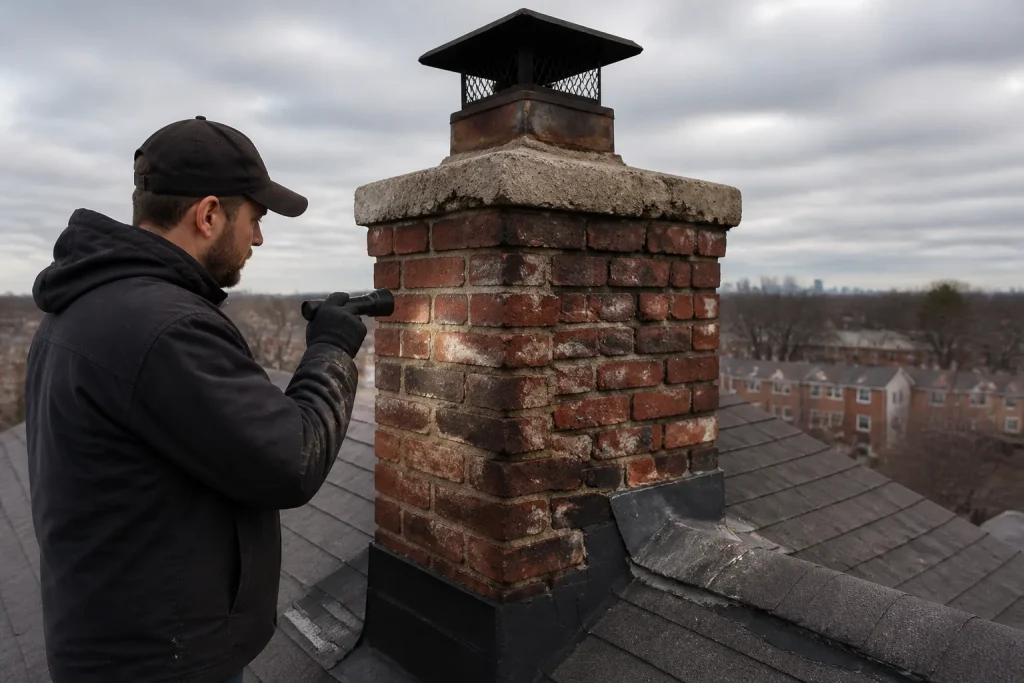
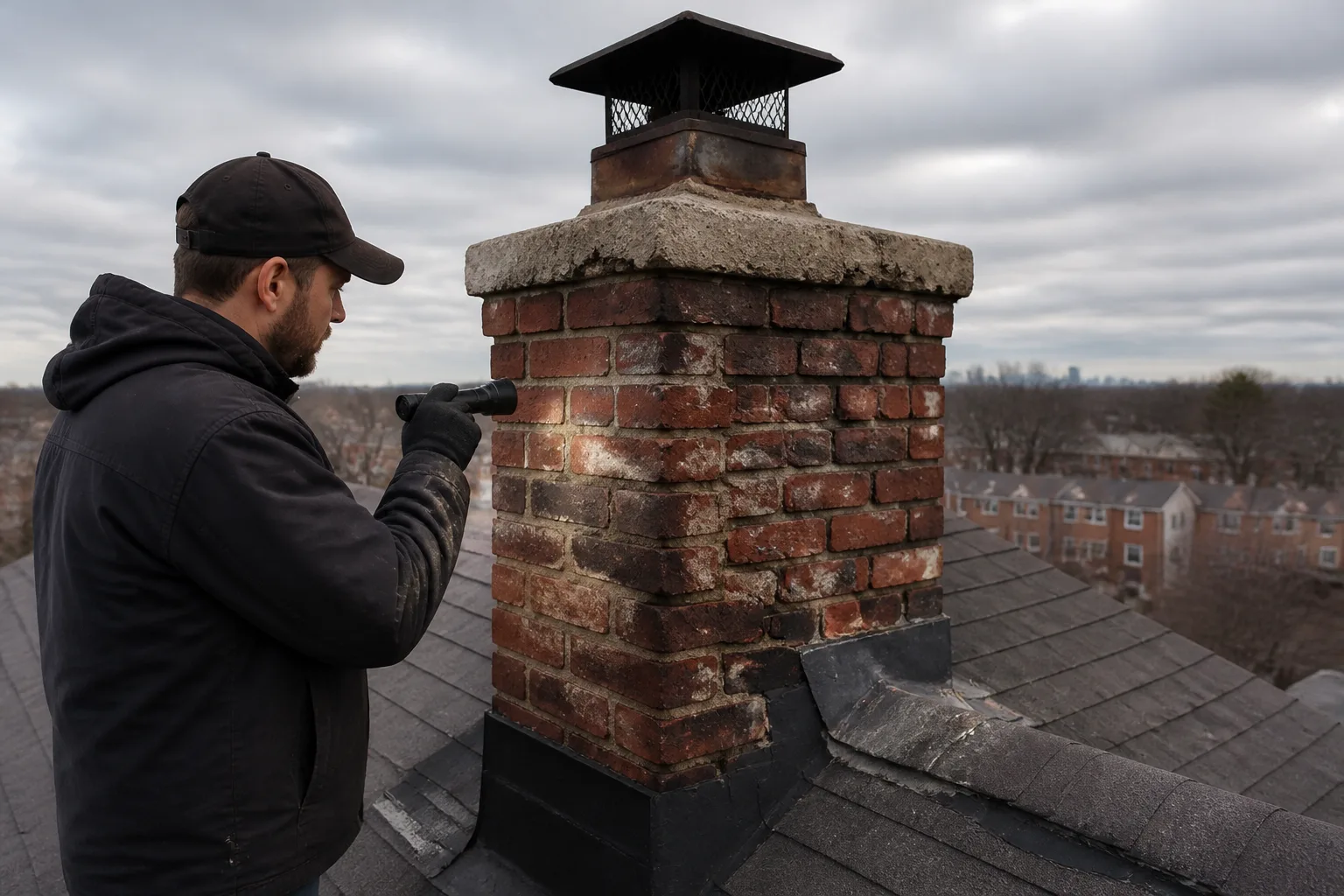
Spalling brick and worn mortar joints are not, on their own, a replacement decision. There’s a threshold. Below it, tuckpointing and repointing extend a chimney’s life by years. Above it, the structure has deteriorated past the point where repair money buys anything durable, and replacement becomes the more honest recommendation.
The thresholds we look at:
- Surface spalling (faces flaking, corners still square). Repairable. Repointing and a moisture-protective crown stop the cycle.
- Deep spalling (brick faces gone, inner material exposed and crumbling). Judgment call. Localized replacement is often worthwhile; whole-chimney replacement of deep spalling starts to compete with a rebuild on cost.
- Mortar joints recessed past roughly the width of the joint itself. Past the point where tuckpointing will hold long term. The joints have lost the material that held the bricks together, and simply adding more mortar to the surface doesn’t rebuild the joint.
- Any visible lean, out-of-plumb sections, or gaps at the roofline. Structural. This is a replacement conversation, and it’s not one to postpone.
Water is what drives most of the spalling we see, which is why we treat the top of the chimney as part of the masonry evaluation and not as an afterthought. A properly fitted chimney cap & crown keeps rain off the flue and out of the brick, and it’s often the cheapest thing that stops a masonry problem from getting worse. If the crown is cracked or missing, that’s where we start.
The Appliance-Change Factor: Why Switching Fuels Changes Everything
Switching an appliance from oil to gas, or from an open fire to a modern insert, almost always requires liner replacement, even when the existing liner looks fine from the outside. The visible condition of the old liner is the wrong question. The right question is whether the liner was built for the appliance that’s going to use it.
Several things happen when the appliance changes. The flue gases change temperature and chemistry, and an older liner may not be rated for the new exhaust. The venting requirements change, and the new appliance has a specified liner size and material it needs to perform correctly. And the old liner may simply be the wrong kind for the new setup, which is exactly the case in many oil-to-gas conversions. When a homeowner asks us whether their working liner can stay, the honest answer is usually no, and here’s the reason we give: the liner is matched to the appliance, not to the flue.
The upside is that a full liner replacement in this situation is a known, well-understood job. Brands like Olympia Chimney build liner systems with the sizing and ratings for these conversions, and once the new liner is in place the appliance operates within its own spec rather than against an old one. If you’re planning a fuel switch or an insert, the right sequence is: inspection first, liner decision second, appliance install third. Doing it in the other order is where homeowners end up paying twice.
Cost Trajectory: Does the Repair Buy 5 Years or 15?
The right question isn’t “what does the repair cost?” It’s “how many years does this repair buy, and does the math favor doing it now or replacing later?” That’s the cost trajectory, and it’s the part of the decision most homeowners never get walked through.
Here’s how we frame it:
- Estimate the service life the repair buys. A reline on an otherwise sound flue typically buys many years of service. A patch on a masonry chimney that’s progressively spalling may buy only a few years before the same conversation returns.
- Estimate the replacement cost if you wait. Repairs rarely get cheaper as damage progresses. What’s a reline today can become a liner-plus-masonry job in three to five years.
- Compare the cost-per-year of each path. A repair that costs a fraction of replacement but only buys four years is usually worse value than replacement that buys twenty-plus. A repair that buys twelve is usually the better call.
- Check what the repair unlocks. Some repairs (repointing plus a new crown) restore the whole chimney to serviceable condition. Others (a liner patch on a flue that’s already shaling) don’t.
In our experience, the homeowners who overspend on replacement are usually the ones who got a gutter-level look and a confident recommendation. The ones who overspend on repair are the ones who patched a problem that was already past the point of patching. Neither happens when the cost trajectory is written down before the work begins.
What a Legitimate Replacement Recommendation Should Include
A replacement recommendation should come with documentation you can actually check. Photos of the flue from the inside, a written condition assessment that names what’s damaged and what isn’t, and the liner sizing specs the recommendation is based on. If you don’t have those three things, you don’t have a diagnosis. You have an estimate.
Here’s what we’d ask for, and what we provide when a Concourse homeowner asks us for a second opinion:
- Before photos from inside the flue. A camera inspection of the flue, not a photo of the outside of the chimney.
- A written condition assessment. Which liner tiles or sections are compromised, how the masonry reads at each level, and the condition of the crown and cap.
- Liner sizing that matches the appliance. The diameter and material the new liner is specified at, and the reason for it.
- A clear statement of what’s structural and what’s cosmetic. Both matter, but only one of them is the reason for the recommendation.
That last point is why we treat chimney sweep and inspection as paired services. The sweep clears the flue so the inspection can see it, and the inspection turns what we find into a plan. When the plan calls for a reline or a masonry repair, we do it in the same visit instead of handing you a report and sending you looking for another contractor. If you’d like that second opinion, call (877) 792-5845. We answer 24/7, with fast dispatch from 7am to 7pm, Sunday through Friday.
Related services in Concourse: chimney repair, chimney cap & crown, fireplace repair, chimney inspection, and Chimney Sweep Concourse. One company, one call.
When to Call a Chimney Pro
Some things are worth a look yourself and some aren’t. A missing cap, a cracked crown, or a puff of smoke into the room when the fire starts is worth a call. A chimney that’s visibly leaning, has gaps at the roofline, or has lost brick faces in large sections is worth a call sooner. And an unexplained smell, a flue that drafts poorly, or an appliance that’s been changed without a liner upgrade is worth a call before the next fire is lit.
What we don’t recommend is climbing up and inspecting the flue yourself. The flue interior, the top of the chimney, and any masonry above the roofline are the parts a trained technician is equipped to evaluate safely, and they’re the parts where a misread can hide a real problem.
The Bottom Line
The repair-or-replace decision comes down to three things: what condition your liner is actually in, whether the masonry around it is still holding the line, and how many years of service each option buys. A cracked clay tile on a sound flue is a reline, not a rebuild. Deep spalling and recessed mortar across the chimney is a replacement conversation early, not late. And an appliance change means a new liner by default, no matter how good the old one looks.
Get the evidence first. Photos, a written condition assessment, and liner sizing specs. Then decide. If you’re in Concourse and need help, Chimney Sweep Concourse offers free estimates. Call (877) 792-5845. We answer 24/7, with fast dispatch from 7am to 7pm, Sunday through Friday. The written estimate sets the final price, and nothing is recommended without camera evidence you can see for yourself.
Frequently Asked Questions
You know from the liner condition and the masonry condition, not from the outside of the chimney. A cracked or damaged liner on otherwise sound masonry is a repair. Widespread liner failure, deep spalling, or structural movement is a replacement. The only way to tell which one yours is, is an inspection that shows the flue from the inside. Call (877) 792-5845 for an exact quote. Estimates are free.
Often, yes. An isolated crack or localized damage in an otherwise intact flue is usually relined with a stainless system or a cast-in-place product. Widespread shaling, multiple broken tiles, or a collapsed section is where relining stops being practical and the liner needs full replacement. A camera inspection tells you which one you’re dealing with. Call (877) 792-5845 to book one.
Almost always, yes. The liner is matched to the appliance, not to the flue. Changing the fuel changes the exhaust temperature, chemistry, and venting requirements, so even a liner that looks fine may not be rated for the new appliance. Plan the liner decision before the appliance install. Call (877) 792-5845 for an exact quote. Estimates are free.
Before photos from inside the flue, a written condition assessment naming what’s damaged and what isn’t, and the liner sizing specs the recommendation is based on. If those aren’t in the recommendation, ask for them, or get a second opinion. We provide all three whenever we recommend a replacement. Call (877) 792-5845 to schedule one.
An annual sweep and inspection is the baseline for a wood-burning chimney, and it’s also the point where the repair-or-replace question gets answered early rather than late. Skipping it is how a reline turns into a rebuild. Call (877) 792-5845 to get on the schedule. Estimates are free.
Written by the team at Chimney Sweep Concourse.
Need Chimney Cleaning Help?
Call Chimney Sweep Concourse - the local pro we connect you with is licensed and insured, here with fast help in Concourse.
(877) 792-5845